
The Tulsa County Clerk
The County Clerk is one of eight elected county officials in every Oklahoma county. The current Tulsa County Clerk is Michael Willis. The office records and preserves land records and other real estate documents. It also acts as the chief administrative officer for county government records, budgets, payroll, retirement-system records, and formal tax protests.
The Tulsa County Clerk home page sets out the office duties, address, and recording hours.
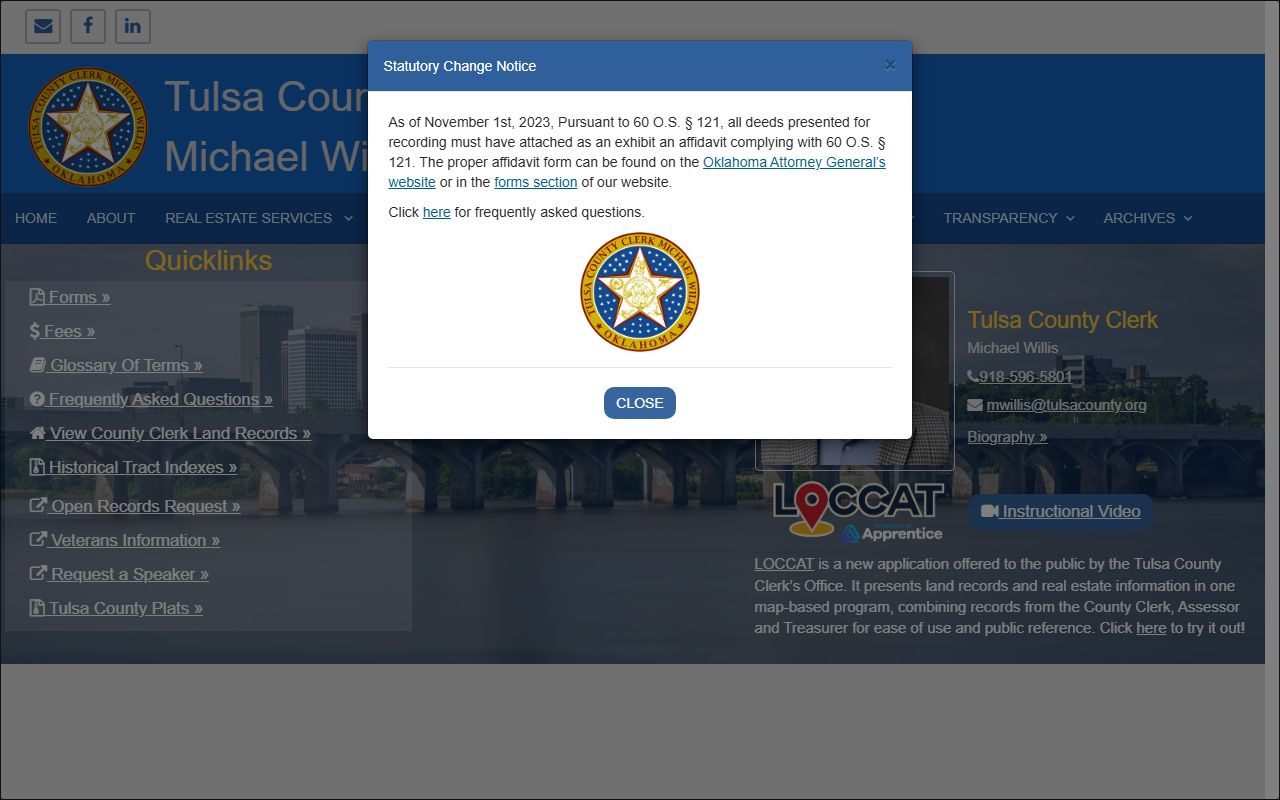
The office is at the county headquarters, not the courthouse, which is a key point for visitors.
This split surprises many people. Someone going downtown for a divorce decree wants the Court Clerk at the courthouse. Someone going downtown for a deed wants the County Clerk at the county headquarters a few blocks away. The County Clerk also sits on the county Budget Board and supports the Employee's Retirement System, which reflects how much of the office's work is county administration rather than courts.
Tulsa County Clerk
218 W. 6th St., 7th Floor
Tulsa, OK 74119-1004
918-596-5801
Recording 8:00 a.m.-4:30 p.m.
What the County Clerk Records
The County Clerk is the recorder for real estate and many related instruments. The Real Estate Services Division processes and preserves documents that go into the public record. Beyond land, the office keeps county government financial and administrative records, board minutes, and business transactions.
- Deeds, mortgages, assignments, and releases.
- Materialmen's, mechanic's, and personal liens.
- Subdivision plats and Tulsa County plats.
- Fictitious name certificates and judgments.
- State and federal tax liens.
- Military discharge papers, such as the DD Form 214.
The office also offers a documentary stamp tax calculator and recording guidelines for the public. It provides standard forms too, such as a quit claim deed, a warranty deed, a release of mortgage, and a release of judgment.
These records are the backbone of property ownership in the county. A deed shows who owns a parcel. A mortgage shows a loan against it. A lien shows a claim by a creditor or contractor. A plat shows how land is divided into lots and blocks. Recording these documents makes them part of the public record and protects the parties involved.
Real Estate Services Division
The Real Estate Services Division splits into two groups. The Recording group takes in documents and places them in the public record. The Land Records group indexes and preserves them. Together they handle deeds, mortgages, liens, plats, and miscellaneous records like military discharges.
The division lists named staff for the public. The County Clerk land records page covers the recording services, the fee schedule, and the search tools.
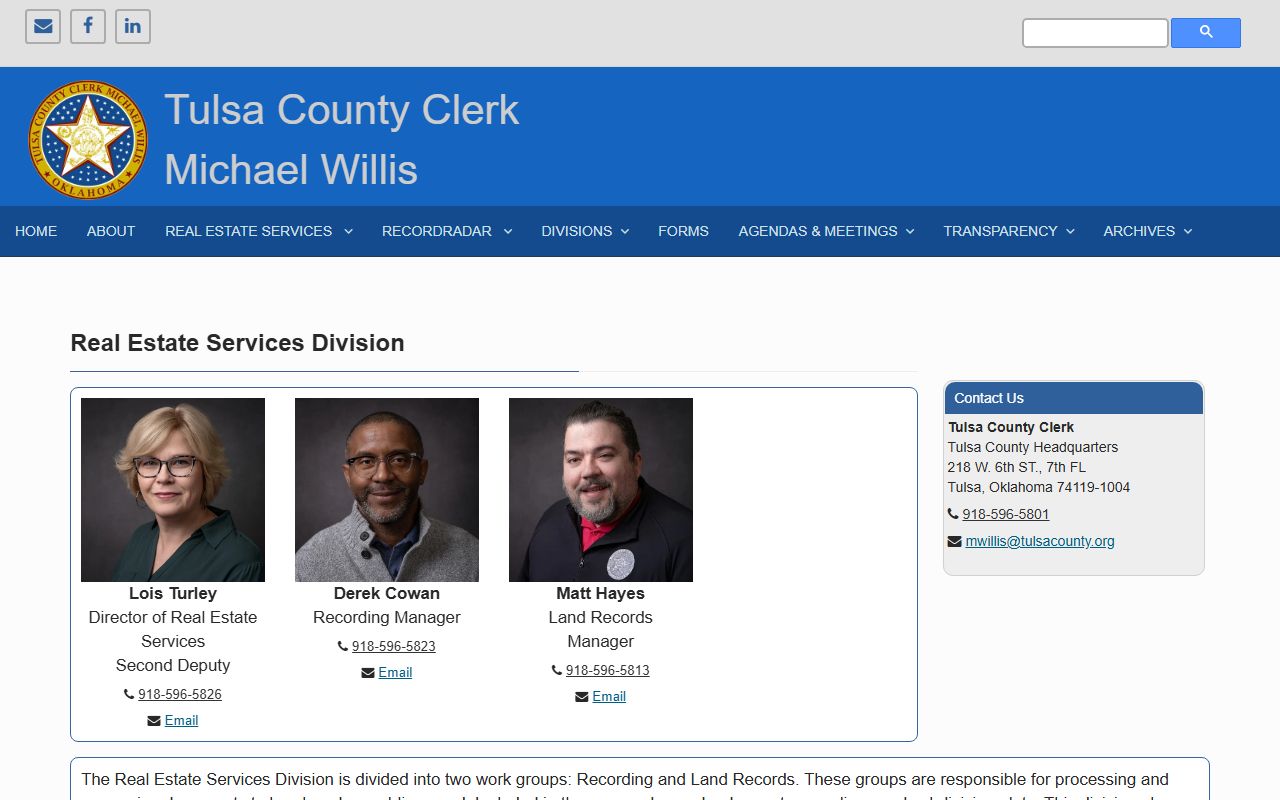
Lois Turley directs Real Estate Services at 918-596-5826, Derek Cowan manages Recording at 918-596-5823, and Matt Hayes manages Land Records at 918-596-5813.
Searching Land Records on Acclaim
Acclaim is the County Clerk's land-records search portal. It is the place to look up recorded documents tied to a property or a name. Some online access requires a paid subscription to search, view, and print records. The free OSCN court docket search is a different system and does not cover land records.
The Acclaim land records portal is the official County Clerk search for recorded documents.
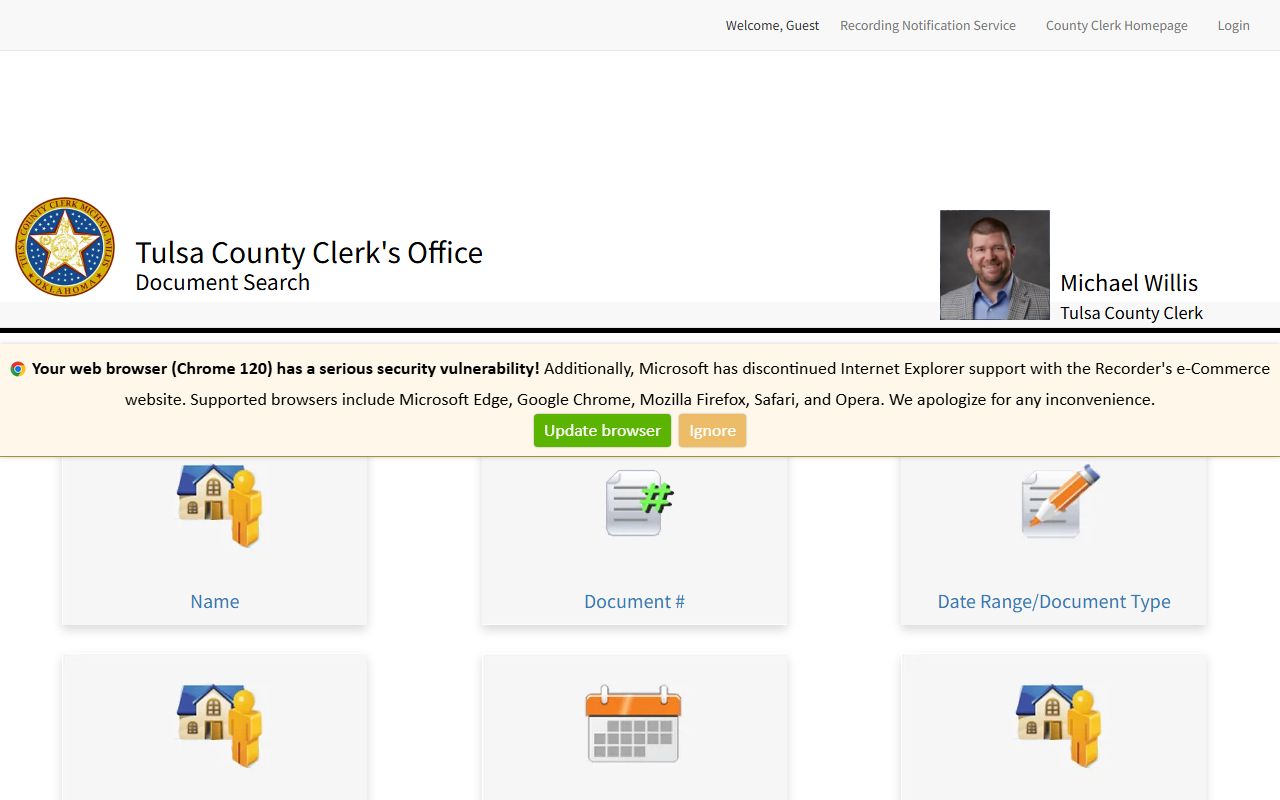
Subscription pricing is listed below, and a property owner can pick the term that fits a one-time or ongoing need.
| Subscription | Price |
|---|---|
| One day / 24 hours | $10.00 |
| One month / 30 days | $30.00 |
| One year / 365 days | $360.00 |
LOCCAT Map-Based Search
LOCCAT is a second County Clerk tool, and it is especially useful. It is a map-based application that combines records from the County Clerk, the Assessor, and the Treasurer in one place. That means a single search can pull recorded documents, assessment data, and tax detail without three separate trips.
LOCCAT also helps when you do not know a parcel number. The County Clerk points users to LOCCAT to find a parcel before setting a property alert. The office also keeps historical indexes, including grantor and grantee indexes, condo and platted tract indexes, and Tulsa County plats back to pre-statehood.
For a title search or a property history, these tools work together. Acclaim and the historical indexes trace a chain of recorded documents over time. LOCCAT ties that chain to a map and to tax and assessment data. A buyer, a researcher, or a title professional can move from a name to a parcel to the recorded instruments without leaving the County Clerk's systems.
RecordRadar Property Alerts
RecordRadar is a free County Clerk alert service. It emails a subscriber when a document is recorded under a registered name or parcel. It is a simple guard against property fraud, such as a fake deed or lien.
The RecordRadar registration page walks through the setup steps.
Register each name variation on its own, add each parcel, and confirm your email to turn the alerts on.
The name-variation step is easy to overlook. The County Clerk advises registering forms like a full middle name, an initial, and a suffix as separate entries, plus company name and its abbreviation. A document recorded under a slightly different spelling can otherwise slip past the alert. The County Clerk also notes that subscription information may itself be subject to public-records law.
| Field | Notes |
|---|---|
| Name | Register each variation, including suffixes and abbreviations. |
| Parcel number | Add each parcel; use LOCCAT if unknown. |
| Email address | Must be active and confirmed through your inbox. |
County Clerk Recording Fees
Recording fees follow a published schedule. Most recorded instruments cost a set fee for the first page and a smaller fee for each added page. Some items, such as a release of certain liens and a military discharge filing, carry no fee. A mortgage may also owe a separate mortgage tax through the Treasurer.
| Item | Fee |
|---|---|
| Deed or recorded instrument, first page | $18.00 |
| Each additional page | $2.00 |
| Plat of one block or less | $20.00 |
| Fictitious name certificate | $15.00 |
| Copy of records, per page | $1.00 |
| Certified copy | $1.00 plus $1.00 per added page |
| Military discharge filing or copy | No fee |
For mortgage tax questions, the office directs people to the Treasurer at 918-596-5071.
A few fees stand out. A non-conforming document costs more, at $35 for the first page, so it pays to follow the recording guidelines. A plat of two blocks or more is $35 rather than $20. The release of certain liens carries no fee at all. When in doubt, check the published recording guidelines before you submit, since a rejected document means a second trip.
E-Recording and Vendors
The County Clerk has accepted electronic filings since August 1, 2004. A contracted e-recording vendor sends a scanned document to the Recording Department. Staff review it, accept or reject it, assign an instrument number and full filing information, and return it electronically to the submitter.
The named e-recording vendors are Simplifile, eRecording Partners Network, Indecomm Global Services, and Corporation Service Company. Documents are accepted for recording Monday through Friday, 8:00 a.m. to 4:30 p.m., except government holidays. The office cannot give legal advice about a document.
E-recording suits businesses that file often, such as title companies and lenders. An individual can still record in person at the counter during recording hours. Either way, an accepted document gets an instrument number and full filing information, which is how it is later found in a search.
County Clerk vs Court Clerk
The two clerks do different jobs. The County Clerk records land and real estate documents and county administrative records. The Court Clerk keeps District Court case files. A deed, a mortgage, or a lien comes from the County Clerk. A divorce decree or a criminal docket comes from the Court Clerk.
The offices sit in different downtown buildings. For court case files and certified court copies, see the Tulsa County Court Clerk page. For the open-records framework that covers both offices, see the public records page.