
The Oklahoma Open Records Act
Oklahoma public records access rests on the Oklahoma Open Records Act, found at 51 O.S. 24A.1 through 24A.30. The Act states a public policy that favors access and inspection. It does not override other laws that make a specific record confidential. A public body must give reasonable access during business hours under 51 O.S. 24A.6.
The state library page lists the full set of Open Records Act sections. The Oklahoma Open Records Act page sets out sections 24A.1 through 24A.30.
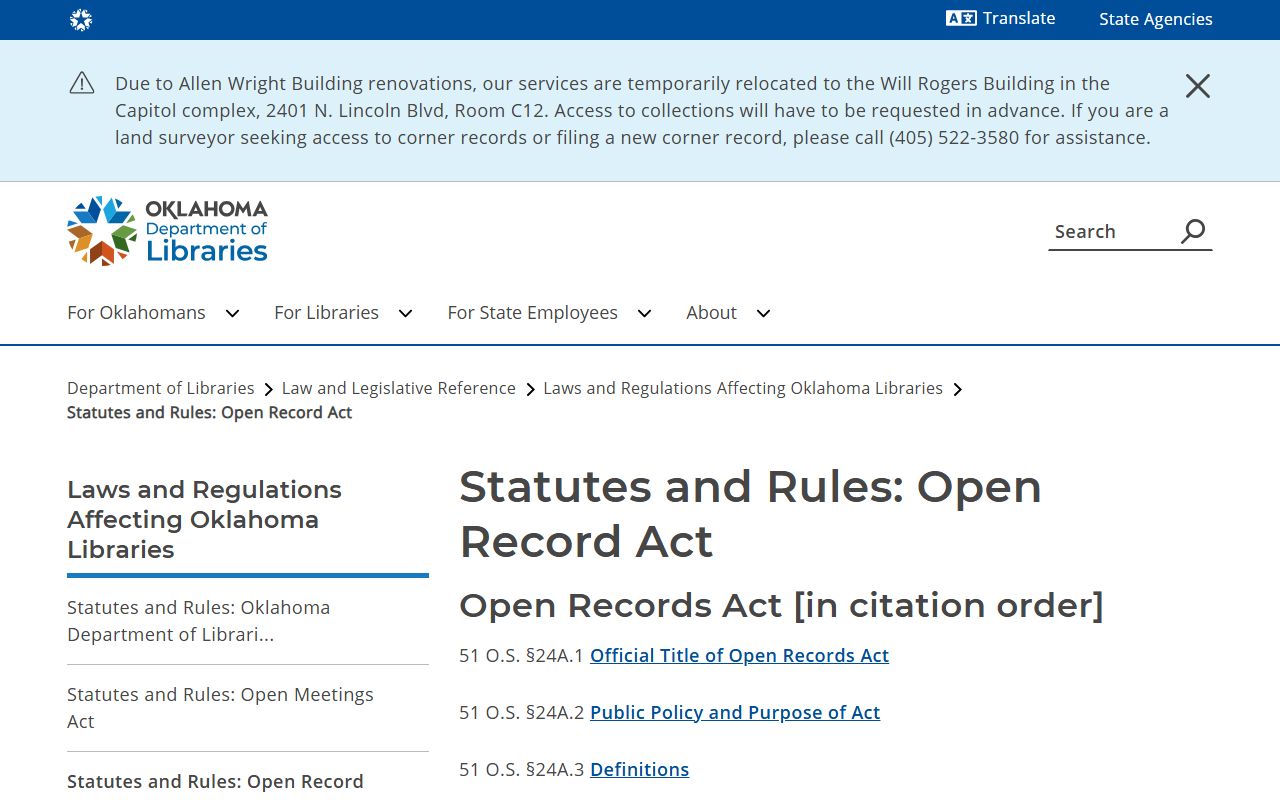
That page is a good first stop to confirm your right to a record before you ask for it.
The Act defines who and what it covers. Under 51 O.S. 24A.3, terms like public body, public official, and record are spelled out. That matters in Tulsa County because a request can go to many different custodians. The Court Clerk, the County Clerk, the Sheriff, the District Attorney, and county departments each keep their own records, and the right office is the one that holds the file.
Court Records vs County Records
The right office depends on the record. The Court Clerk keeps District Court case files. The County Clerk records land and real estate documents and county administrative records. The Sheriff holds jail and law-enforcement records. Sending a request to the wrong office slows it down.
| Record | Office | How to Reach It |
|---|---|---|
| Court case files | Court Clerk | OSCN search, then the Court Clerk |
| Land and deed records | County Clerk | Acclaim and LOCCAT |
| Jail and arrest records | Sheriff | Inmate roster and TCSO |
| County budgets and minutes | County Clerk | County Clerk office |
For court files, start with the Tulsa County court records page. For land records, see the County Clerk page.
Law Enforcement Records
Law-enforcement records have their own rule. Under 51 O.S. 24A.8, certain law-enforcement records are open for public inspection. This covers basic booking, arrest, and incident information. It still allows an agency to withhold investigative or confidential material.
The line between an open booking record and a closed investigation matters. A jail roster entry is public, but an active investigation file may not be. The Sheriff and the District Attorney can withhold litigation and investigatory materials under 51 O.S. 24A.12. The arrest records page covers the booking side.
Where you ask depends on what you want. A booking record is on the Sheriff's roster. A police incident report comes from the agency that wrote it. A charging decision and the court file come from the District Attorney and the Court Clerk. For one event, you may need to ask more than one office, since each holds a different piece.
County Clerk Land Records
Land records are a large part of Tulsa County public records. The County Clerk records deeds, mortgages, liens, plats, and related documents. The office runs the Acclaim search portal and LOCCAT, a map-based tool that combines County Clerk, Assessor, and Treasurer data in one place. LOCCAT is handy because it spares you a trip between three offices.
Some online County Clerk record access requires a paid subscription. The listed prices are $10 for one day, $30 for one month, and $360 for one year to search, view, and print records online. This is separate from the free OSCN court docket search, and the two should not be confused.
The County Clerk also keeps the county's administrative records. That includes budgets, board minutes, payroll, and business transactions, because the office serves as the chief record keeper for county government. The Real Estate Services Division splits into recording and land records, and it processes the documents that go into the public record, such as deeds, mortgages, liens, and plats.
RecordRadar Alerts
The County Clerk offers a free alert tool called RecordRadar. It emails a subscriber when a document is recorded in the County Clerk's office under a registered name or parcel. It is a simple guard against property fraud and surprise filings.
Setup is straightforward but specific. Register each name variation on its own, including suffixes and company abbreviations, and add each parcel number you want to watch. Confirm your email through your inbox to turn the alerts on. If you do not know a parcel number, the County Clerk points you to LOCCAT to find it.
The tool is most useful for property owners worried about fraud. If someone tries to record a fake deed or lien against your property, an alert lets you act quickly. The County Clerk notes that the subscription information itself may be subject to public-records law, and the office cannot give legal advice about what to do next.
Confidential Records
Not every government record is open. The Act itself, at 51 O.S. 24A.5, says it does not reach records that another law keeps confidential. That carve-out supports withholding several categories the public often asks about.
The OSCN statute page sets out this section in full. The Open Records Act at 51 O.S. 24A.1 frames the access right that the later sections then limit.
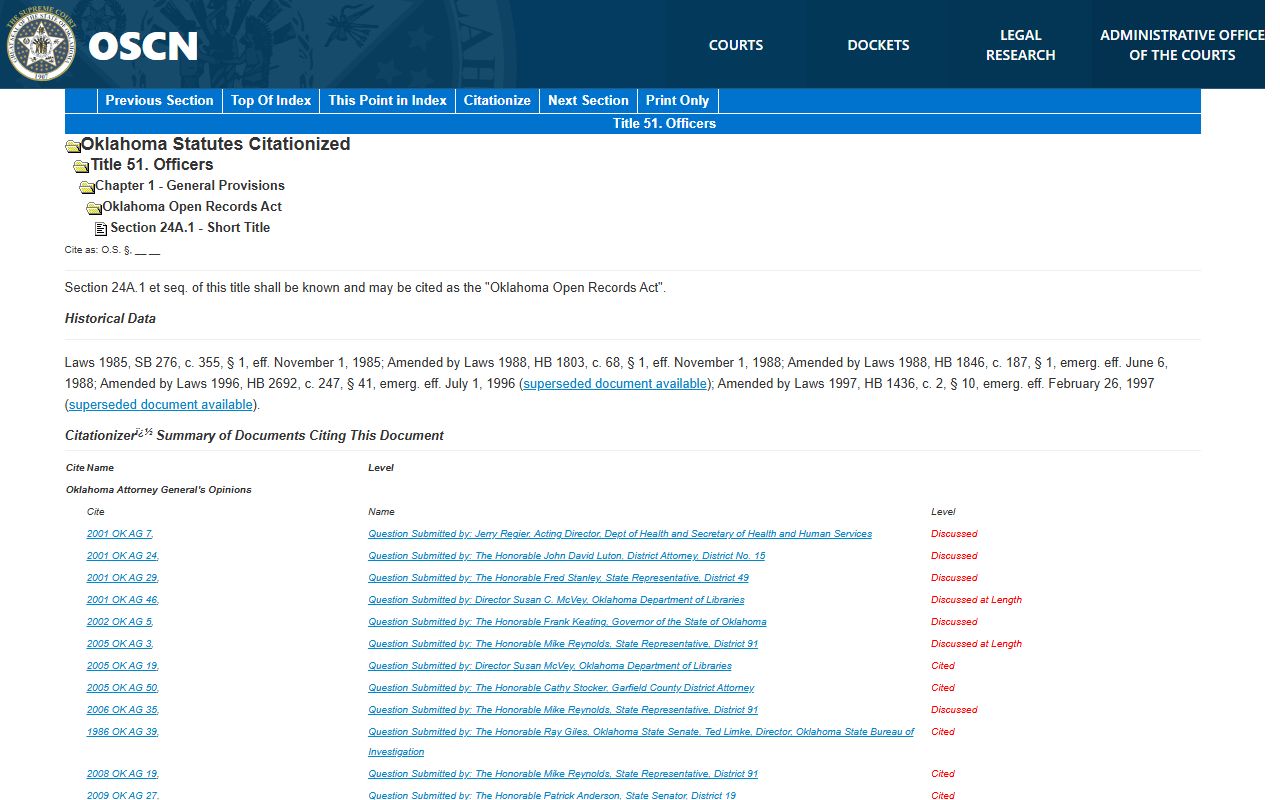
Common closed categories include juvenile, adoption, mental health, sealed and expunged records, and protected personal identifiers, as well as some active investigation files.
- Juvenile case and child welfare records.
- Adoption records after a final decree.
- Mental health case files.
- Sealed and expunged criminal records.
- Social Security numbers and protected account data.
How to File a Public Records Request
A clear request gets a faster answer. First, figure out which office holds the record. Then describe the record well enough that staff can find it. You can usually inspect records in person or ask for copies for a fee. There is no special form for most requests, and you do not have to say why you want the record.
- Identify the office that keeps the record: Court Clerk, County Clerk, Sheriff, or another department.
- Describe the record by type, names, dates, and case or instrument number.
- Say whether you want to inspect the record or get copies.
- Ask whether the copies need to be certified.
- Provide your contact information and submit during business hours.
- Pay any copy or certification fee when the office responds.
Fees and Certified Copies
Copy fees vary by office. The County Clerk lists a copy of records at $1.00 per page and a certified copy at $1.00 plus $1.00 for each additional page. Court record copies and certification come from the Court Clerk. A certified copy carries an official seal and is the version a court or agency will accept.
| Item | Fee |
|---|---|
| County Clerk copy of records, per page | $1.00 |
| County Clerk certified copy | $1.00 plus $1.00 per added page |
| County Clerk web subscription, one day | $10.00 |
| County Clerk web subscription, one year | $360.00 |
| OSCN court docket search | Free |
Free online docket searching is not the same as a certified copy, which still carries a fee at the counter.
What to Include in a Records Request
A request that names the right details moves faster. The table below lists the fields that help an office locate a Tulsa County record. Not every field applies to every record, but more detail rarely hurts.
| Field | Why It Helps |
|---|---|
| Record type | Tells the office which file to pull. |
| Names | Party, owner, or person tied to the record. |
| Date or date range | Narrows the search window. |
| Case or instrument number | The fastest way to find an exact record. |
| Inspect or copy | Sets the response and any fee. |
| Requester contact | Lets the office reply and quote a fee. |
One last tip: keep your request specific but not so narrow that it misses the record. If you are unsure of the exact title of a document, describe what it is and when it happened, and let the staff match it. A short, clear request is easier to fill than a vague one or an overly broad one. For office details, see the Court Clerk and County Clerk pages.