
The Tulsa County District Court
Oklahoma's primary trial court is the District Court, and every one of the state's 77 counties has one. Tulsa County's District Court is in Judicial District 14, which it shares with Pawnee County. The Court Clerk's office provides personnel for 35 District, Associate, and Special Judges. The court handles the full range of county cases, from the most serious felonies to small claims disputes.
The court of record is where a case officially lives. For most felonies, misdemeanors filed by state or county agencies, civil suits, divorce, probate, guardianship, protective orders, small claims, and Highway Patrol or Sheriff tickets, the Tulsa County District Court is that court. The Court Clerk keeps the records, and the public reaches them through OSCN.
Tulsa County also holds a place in Oklahoma's electronic court history. The Court Clerk says the county was the first in the state to put the Oklahoma Court Information System in place, in October 1999. That early start is part of why so much of the District Court's docket is searchable online today, decades before many counties caught up.
Oklahoma's Court Hierarchy
Oklahoma is unusual at the top. It has two courts of last resort. The Oklahoma Supreme Court decides civil matters and runs court administration. The Oklahoma Court of Criminal Appeals decides criminal matters. The Court of Civil Appeals is the middle appellate court for assigned civil cases. Below them, the District Courts do the trial work.
Case flow: District Court › Court of Civil Appeals or Court of Criminal Appeals › Oklahoma Supreme Court
| Court | Role | Hears |
|---|---|---|
| Oklahoma Supreme Court | Civil court of last resort | Final civil appeals, administration |
| Court of Criminal Appeals | Criminal court of last resort | Final criminal appeals |
| Court of Civil Appeals | Intermediate appellate | Assigned civil appeals |
| Tulsa County District Court | Trial court, District 14 | Criminal, civil, family, probate, traffic |
| Municipal Court | City court | City ordinance and city traffic |
District Court Divisions and Departments
The District Court's work splits across departments under the Court Clerk. Each handles a slice of the docket, and most sit in the courthouse at 500 South Denver Avenue. Juvenile cases are heard at a separate downtown facility. The table below lists the main divisions and their direct lines where published.
| Division | Location | Phone |
|---|---|---|
| Tulsa County Courthouse | 500 S. Denver Ave. | 918-596-5000 |
| Criminal and Traffic | Courthouse, Room 200 | 918-596-5479 |
| Civil | Courthouse | 918-596-5430 |
| Family | Courthouse | 918-596-5445 |
| Probate | Courthouse, Room 200 | 918-596-5439 |
| Juvenile Justice Center | 500 W. Archer St. | 918-596-5420 |
Official sources do not list every numbered judge's courtroom and direct line, so confirm a specific judge's chambers with the Court Clerk. The Civil Department handles suits over $10,000, while Small Claims covers money claims under that amount and most evictions. The Criminal and Traffic Department takes filed cases from more than twenty-five law enforcement agencies across the county.
District Court vs Municipal Court
The District Court is not the only court in Tulsa County. Cities run their own municipal courts for city ordinance and city traffic cases. A City of Tulsa Police ticket goes to the municipal court, not the District Court. This split confuses many people, since the buildings sit close together downtown.
| Point | District Court | Municipal Court |
|---|---|---|
| Handles | Felonies, civil, family, probate, state tickets | City ordinance and city traffic |
| Records | Court Clerk and OSCN | The city's municipal court |
| Example | Sheriff or Highway Patrol ticket | City of Tulsa Police ticket |
Municipal courts operate in Tulsa, Broken Arrow, Bixby, Owasso, Sand Springs, and other cities across the county. The Court Clerk does accept payment for some state tickets, such as Highway Patrol and Sheriff citations issued in Tulsa County, but it sends City of Tulsa Police tickets next door to the municipal side. Getting this right saves a wasted trip to the wrong counter.
How a Case Moves Through the System
A case follows a path from filing to a possible appeal. A criminal case opens with the District Attorney filing an Information. A civil or family case opens with a petition. The District Court hears the matter, and the docket records each step. If a party appeals, the case moves up.
The appeal path depends on the subject. A criminal appeal goes to the Court of Criminal Appeals. A civil appeal goes through the Supreme Court and the Court of Civil Appeals. The flow runs from the District Court up to the right high court, which is why OSCN links District Court results to appellate search fields.
Most cases never reach an appeal. They resolve at the District Court level through a plea, a settlement, a judgment, or a dismissal. The docket records the result either way. When you read a case, the disposition line tells you how it ended, and an appeal entry tells you if it moved up.
Court-Related Offices
Several offices work alongside the District Court. The District Attorney reviews police work and decides whether to file charges. Steve Kunzweiler is the Tulsa County District Attorney, leading an office of roughly 50 attorneys and 70 support staff. The main DA line is 918-596-4805.
The Public Defender represents people who cannot afford a lawyer. The Tulsa County Public Defender page describes the county office.
Lora Howard was named Chief Public Defender, leading the office that handles indigent defense in the District Court.
Specialty Courts in Tulsa County
The District Court runs problem-solving courts that focus on treatment. The Tulsa County Alternative Court Programs office calls itself the oldest drug and treatment court in the state. Its dockets include Drug Court, DUI Court, Veterans Treatment Court, Mental Health Court, and Reentry Court. Judge Dawn Moody supervises the program.
The Tulsa County Alternative Court Programs page describes the dockets and the staff who run them.
These courts pair judicial supervision with treatment and case management, rather than custody alone.
Drug court is a statewide model as well as a local one. The Oklahoma drug courts page explains the state program for nonviolent felony offenders.

Oklahoma's first adult drug court began in 1995, and the model grew to most of the state's counties over the following years.
Federal Courts Serving Tulsa County
Federal cases do not go through the District Court or OSCN. Tulsa County is in the U.S. District Court for the Northern District of Oklahoma. A separate federal courthouse downtown handles federal criminal and civil cases. Bankruptcy and federal appeals each have their own court.
Bankruptcy is its own federal court, not a county matter. The U.S. Bankruptcy Court for the Northern District of Oklahoma handles those cases downtown.
The bankruptcy court is not at the county courthouse and is not searched through OSCN. Federal records are reached through PACER and the court's electronic filing system instead.
Federal appeals from the Northern District go to the Tenth Circuit. The U.S. Court of Appeals for the Tenth Circuit hears those appeals.
Federal prosecutions are brought by the U.S. Attorney rather than the county District Attorney.
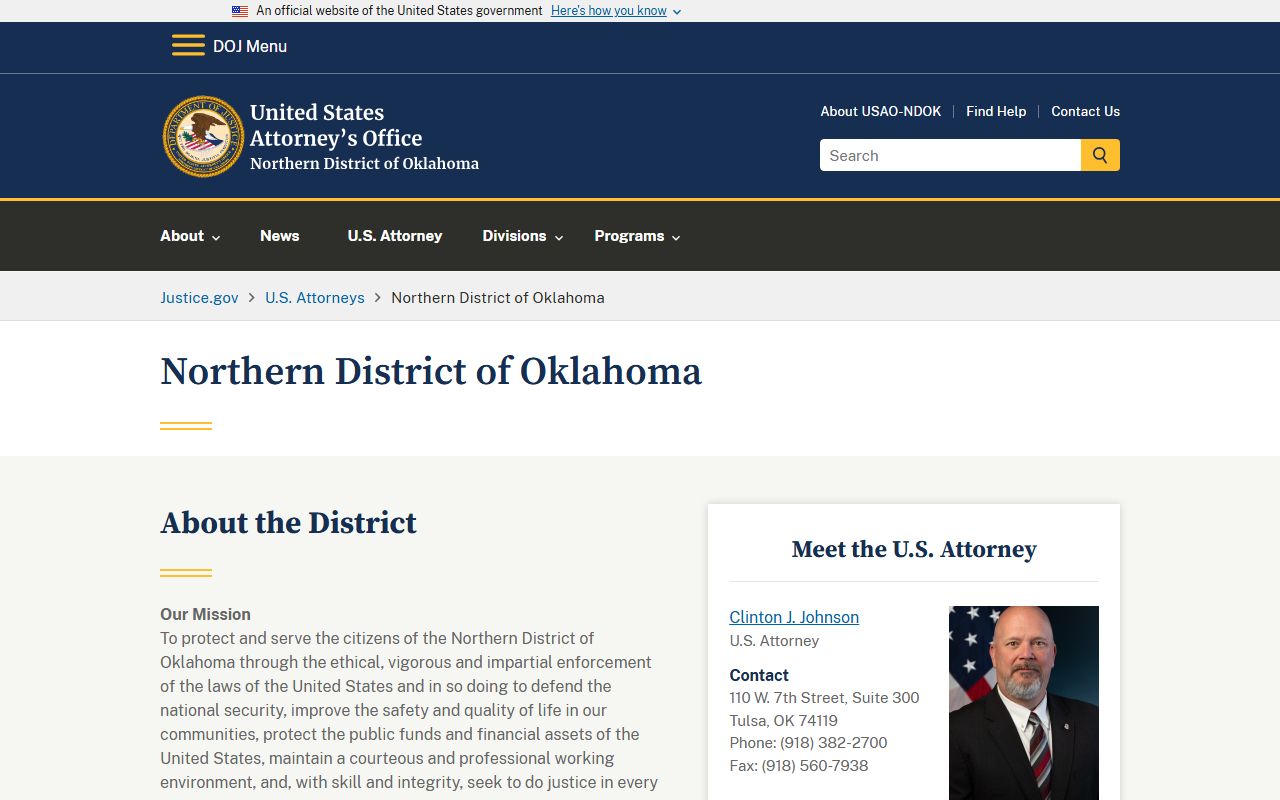
The U.S. Attorney for the Northern District of Oklahoma handles federal criminal cases in Tulsa.
A person can have both a state District Court case and a federal case, so a full search may need both systems.
The Courthouse and Juvenile Justice Center
The Tulsa County Courthouse at 500 South Denver Avenue is the heart of the District Court. The Court Clerk's departments fill the second floor. Juvenile cases moved to the Juvenile Justice Center at 500 West Archer Street, where four juvenile judges hear offense cases. Detention for juveniles, when needed, is handled at the David L. Moss facility.
The courthouse complex is unusually concentrated downtown. The Court Clerk, the District Court, the municipal ticket area, and the David L. Moss jail all sit in or near the Civic Center on Denver Avenue. For records and search help, see the Tulsa County court records page, the court dockets page, and the Court Clerk page.