
The Tulsa County Probate Department
Probate in Tulsa County runs through the Court Clerk, not a separate probate court. The Probate Department is in the courthouse at 500 South Denver Avenue, Room 200. The department head is Geri Bauhaus, and the department phone is 918-596-5439. Staff can answer filing and copy questions, but they cannot give legal advice.
The Court Clerk probate page lists wills safekeeping, estate filing, and the confidentiality rules for guardianship, adoption, and mental health cases.
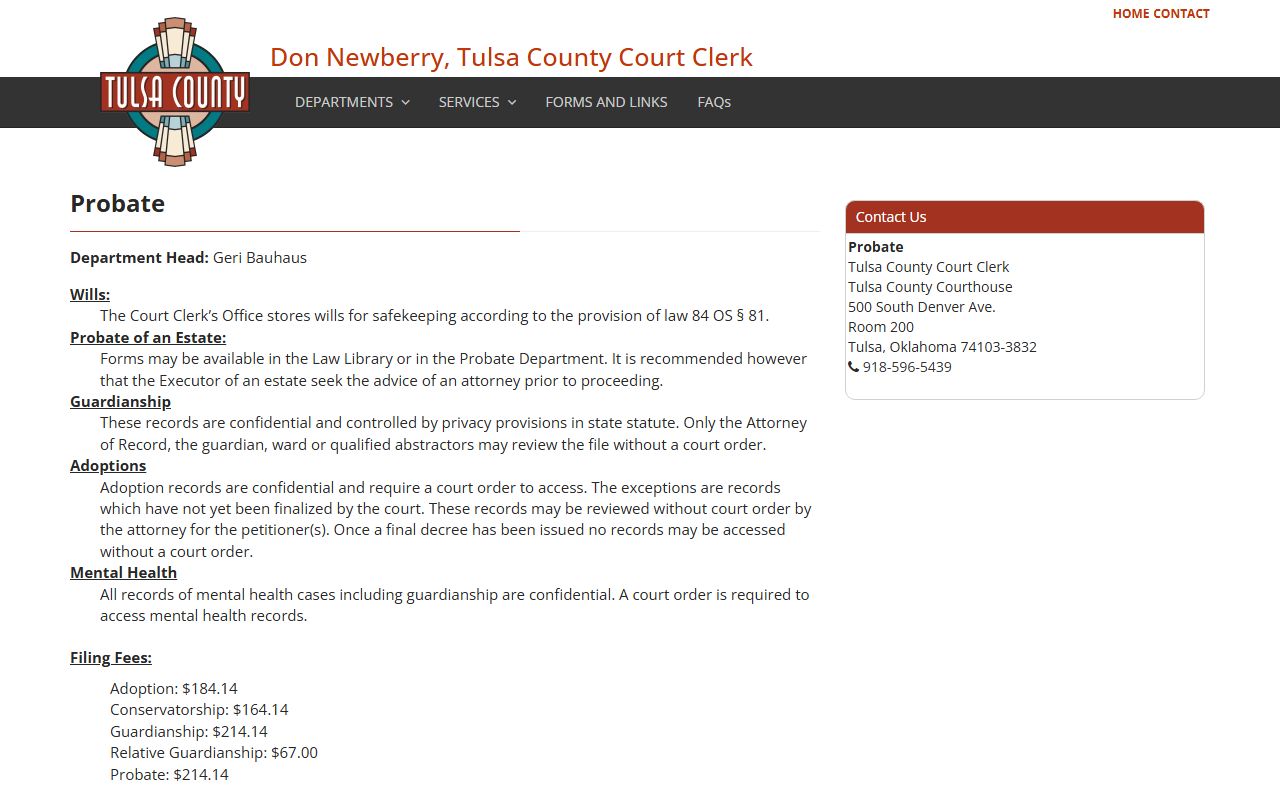
That page is the official source for the fees and restrictions below.
Tulsa County Probate Department
500 South Denver Ave., Room 200
Tulsa, OK 74103-3832
918-596-5439
Mon-Fri 8:00 a.m.-5:00 p.m.
What Probate Covers in Tulsa County
Probate is broader than just estates. It covers the legal steps after a death, plus several matters that protect people and property. The Probate Department handles estate probate, wills safekeeping, guardianships, conservatorships, adoptions, and mental health filings. Each one uses the District Court system.
An estate probate settles a person's property and debts after death. A guardianship protects a minor or an adult who cannot manage their own affairs. A conservatorship manages another adult's money. Adoption makes a legal parent-child relationship. Mental health proceedings address treatment and care. These cases share a department but follow different rules and fees.
Because Oklahoma folds probate into the District Court, there is no separate surrogate or orphans' court here. That is different from some states. For a Tulsa County resident, it means one office and one court system handle a probate case, alongside criminal, civil, and family matters. The case still uses the same OSCN docket system as any other District Court file.
Tulsa County Probate Filing Fees
Filing fees depend on the case type. The Probate Department lists the figures below. Fees can change, so confirm the current amount with the department before you file. Filing fees are paid at the time of filing.
| Probate Filing | Fee |
|---|---|
| Probate (estate) | $214.14 |
| Guardianship | $214.14 |
| Relative guardianship | $67.00 |
| Conservatorship | $164.14 |
| Adoption | $184.14 |
Verify any fee at 918-596-5439, since these amounts can be updated. The figures above include statutory costs, which is why several end in odd cents rather than a round dollar amount.
How to Search Tulsa County Probate Records
Public probate cases are searchable on OSCN. Open the Tulsa County docket search and choose the Probate case type, or Probate Miscellaneous Proceedings. You can search by the decedent's or person's name, or by case number. Probate cases may carry a PB or PROB prefix depending on the year.
A probate docket can show the petition, an order admitting a will, letters testamentary or of administration, an inventory, notice to creditors, a final accounting, and a closing order. Confidential cases, such as guardianship and adoption, may not appear in full to the public. The Tulsa County court records page explains the OSCN search fields.
A name search is the usual starting point for an estate. Search the decedent's name to see whether a probate case was opened. If it was, the docket tracks the estate from the first petition to the closing order. If no case appears, the estate may not have gone through formal probate, or the matter may be too recent to post. A call to the Probate Department can clear up which it is.
Wills and Safekeeping
The Court Clerk can hold a will for safekeeping. The Probate Department says it stores wills under the state statute at 84 O.S. 81. A will held this way is kept until it is needed, often after the maker's death, when probate may begin. The Records and Archives policy also says wills, trusts, and certain docket information are never destroyed.
For estate probate itself, the department says forms may be available in the Law Library or the Probate Department. It also recommends that an executor seek attorney advice before proceeding, because an estate involves notice, inventory, creditor claims, and a final distribution.
Safekeeping is a quiet but useful service. A person can leave a will with the Court Clerk so it is not lost or destroyed. That matters because a misplaced will can complicate an estate. When the maker dies, the will can be located and the probate process can begin from a known document rather than a search of personal papers.
Guardianship and Conservatorship Records
Guardianship records are confidential. The Probate Department says they are controlled by a privacy statute. Without a court order, only the attorney of record, the guardian, the ward, or a qualified abstractor may review them. A conservatorship, which manages an adult's finances, falls under the same protective approach.
This means a member of the public usually cannot pull a full guardianship file the way they can a civil suit. The case may show in the system, but the documents are limited. If you have a legal interest, ask the Probate Department how to request access.
Guardianship and conservatorship cases often involve a vulnerable person, which is why the law shields them. A family member who is a party, or that person's attorney, has a clearer path to the file than the general public. The court can also order broader access when there is a good reason, but that takes a request and a judge's approval.
Adoption Record Restrictions
Adoption records are among the most protected files. The Probate Department says adoption records are confidential and require a court order once a final decree is issued. Before the final decree, the attorney for the petitioners may review without a court order.
This rule protects the privacy of the child and the families involved. A person seeking an adoption record after finalization generally needs a court order and a legal basis. Do not expect adult-style public access to a finalized adoption file. The restriction holds even years later, which surprises some people who try to look up an old case.
Mental Health Records
Mental health case records carry the strongest restriction. The Probate Department states that all mental health case records, including guardianship tied to them, are confidential and require a court order. Public searchers should not expect normal OSCN access to these files.
Important: Guardianship, adoption, and mental health probate records in Tulsa County are confidential and generally require a court order or a qualifying legal interest to view.
Probate Terms Defined
Probate uses words that rarely come up elsewhere. A short glossary helps before you read a file or talk to the department.
- Testator
- The person who made the will.
- Executor
- The person named in a will to settle the estate.
- Intestate
- Dying without a valid will, so state law decides who inherits.
- Guardianship
- Court authority to care for a minor or an adult who cannot manage alone.
- Conservatorship
- Court authority to manage another adult's money or property.
- Letters testamentary
- The court order giving an executor authority to act.
How to File a Tulsa County Probate Case
A probate filing follows a set path. The exact steps depend on whether it is an estate, a guardianship, or another matter. The list below outlines the common route, and the department can confirm what your case needs.
- Identify the matter: estate, will safekeeping, guardianship, conservatorship, adoption, or mental health.
- Search OSCN by name or case number to check for an existing case.
- Call the Probate Department at 918-596-5439 with filing or copy questions.
- Use the Probate Cover Sheet from the Court Clerk forms page.
- Pay the filing fee from the county schedule.
- Plan for attorney help on an estate, including notice and final accounting.
Plan for time as well as fees. An estate can take months to move from the first petition to a closing order, because notice periods and creditor claims have their own deadlines. Keeping the case number handy makes each later step, from a copy request to a status check, far easier. For related records, see the marriage and divorce records page and the Court Clerk page.